Foundation course - semesters 1 and 2
Build the essentials of mathematics, natural sciences, engineering, information technology and international studies during the orientation phase.
Seven semesters, four progressive phases and a project in every theoretical study year lead to the Bachelor of Engineering.
The programme combines engineering foundations with international dimensions of professional practice and leaves room to discover specialisations before choosing an individual profile.
Build the essentials of mathematics, natural sciences, engineering, information technology and international studies during the orientation phase.
Expand your specialist knowledge and apply it in practical group projects such as quality management and mechatronic systems.
Complete a 24-week professional phase, including a practice-related teaching block, in Germany or abroad and gain engineering-specific work experience.
Choose compulsory electives that match your interests. Complete the programme with a 12-ECTS Bachelor's thesis and a 3-ECTS colloquium.
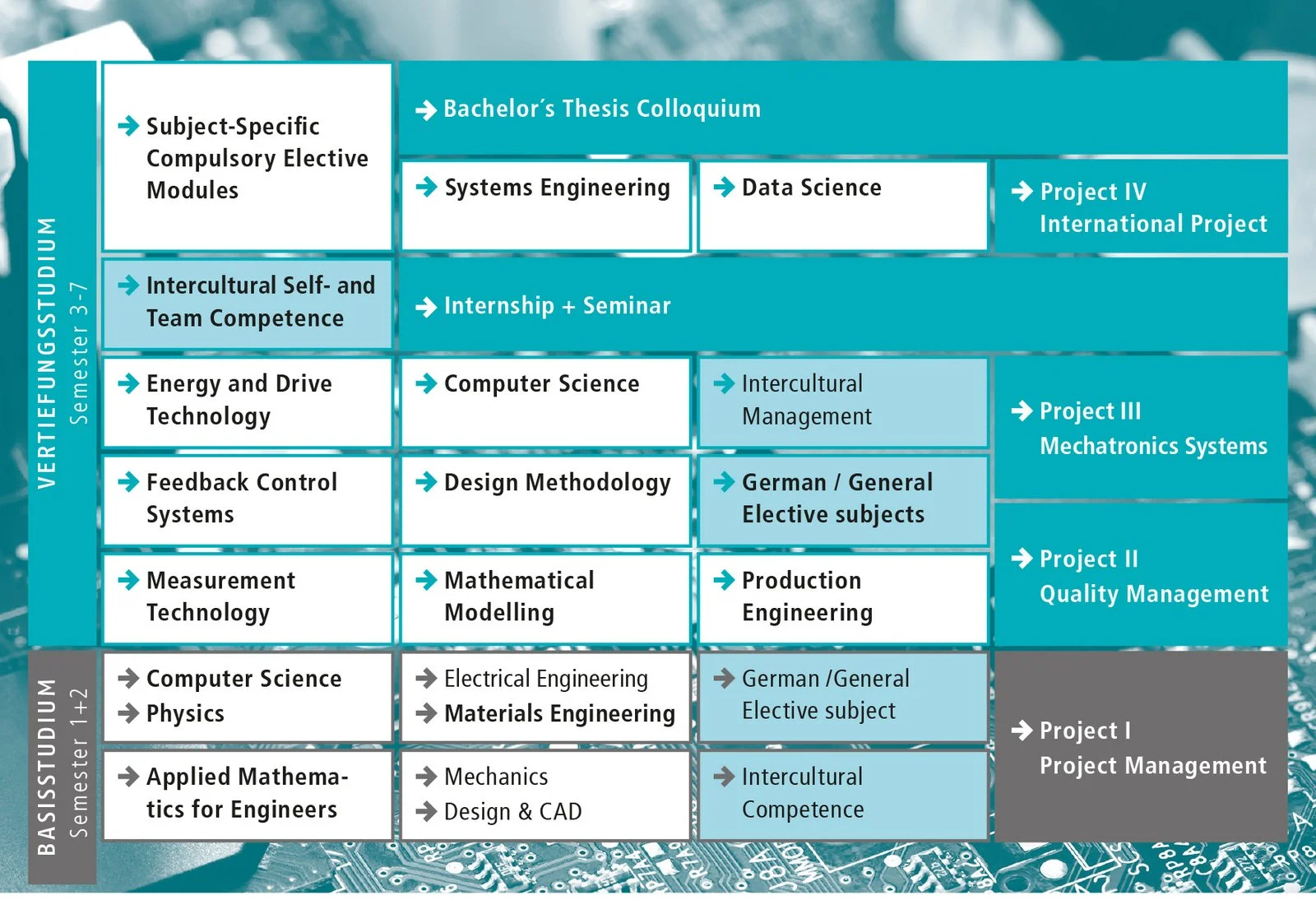
The curriculum assigns 210 ECTS across seven semesters. Track A includes German as a Foreign Language; students who already prove German B1 are assigned to Track B and select general electives instead.
A specialisation is shown on the academic record when the required 15 ECTS are completed in that profile. Choosing International Studies requires completing the corresponding modules during a semester abroad.
Options include signal processing, electronic devices, finite element analysis, energy engineering, sustainable energy systems, mobile robotics, electronics manufacturing and human-machine interaction.
The didactic concept is built around project-based learning. Group projects apply and deepen each semester's content while developing transferable skills, teamwork and structured technical communication.
Project I focuses on project management, Project II on quality management, Project III on mechatronic systems and Project IV on an international engineering project.
The practical semester lasts 24 weeks in total, including a three-week practice-related teaching block. You work in an engineering-specific role and prepare purposefully for professional entry.
The internship may be completed in Germany or abroad. The placement must fulfil the programme requirements and should be coordinated with the responsible internship officer.
A semester abroad is optional for most students. It is required only if you choose the International Studies specialisation; the corresponding modules are completed at a university abroad. You may also choose to complete your practical semester abroad.
The global network enables students, lecturers and staff to spend time abroad in their preferred country and strengthens international exchange in teaching and research.
An academic semester or approved internship abroad is optional unless you select International Studies. Plan early because destinations, applications, recognition, financing, accommodation and residence requirements differ.
ECTS supports transparency, but recognition must be coordinated. Discuss the intended modules or internship with the responsible university contacts before travelling.
Current service fees apply to students from non-EU countries in English-taught programmes. Check the official university page for the current amount and conditions.
View current service feesWould you like to connect theory and practice even more closely? International Engineering can be combined with extended company experience through two dual-study formats.
Combine the regular Bachelor's programme with intensive, coordinated practical phases at a partner company. You apply university content directly, get to know operational processes and can enter this format during the early part of your studies, subject to the current rules and a suitable contract.
Combine the Bachelor of Engineering with a fully recognised vocational qualification. The programme alternates university study, vocational education and practical company phases, leading to both an IHK qualification and the academic degree.
Use these documents for binding regulations, detailed module information and a compact programme overview.
Use the official module handbook, study and examination regulations and current mobility information as the binding sources.